Here’s what’s on my playlist this week. It’s virt-heavy. Be prepared.
- Jake Kaufman – Might Switch Force OST
- Jake Kaufman – Mighty Milky Way OST
- Whitaker Blackall – Cardinal Quest: Original Soundtrack
- Genki – Tokyo Xtreme Racer Soundtrack

Sometimes I make games. Sometimes I make websites. This is my blog.
Here’s what’s on my playlist this week. It’s virt-heavy. Be prepared.
Staying at the Hotel Victoria in downtown Toronto for the last week with my girlfriend Amy has opened us to a ton of new, fantastic vegetarian and vegan restaurants. Google has helped us find them all, but I wanted to take a second to put together a small list in case you’re downtown Toronto for a while and are looking for great places to eat.
I’ll separate them by category.
Pizzaiolo
http://www.pizzaiolo.ca/
There are probably 15 to 20 of these around Toronto, but the one we went to was just a few doors down from our hotel on Yonge St. It was amazing. In fact, it was so amazing, we ordered pizzas there two days in a row. They have a ton of vegetarian and vegan choices and each are made fresh right in front of you. It’s amazing.
Urban Herbivore
http://www.torontoeatoncentre.com/EN/Directory/Stores/Pages/UrbanHerbivore_F018.aspx
Like most food places in Toronto, there are a few locations. The one we went to was in the Eaton Centre, and it was fantastic. I ate the BBQ Tofu sandwich and loved it even though I’m not normally a huge fan of tofu. It was quick and cheap. Like all great vegetarian food, if you didn’t know it was vegetarian you wouldn’t be able to tell.
 Fresh
Fresh
http://www.freshrestaurants.ca/our_history.asp
Fresh was, without a doubt, our favourite. It’s got great style, it’s busy, it’s fast, and the food tastes fantastic. Amy loved it so much she bought one of the recipe books they offer on sale.
King’s Cafe (Kensington Market)
http://www.kingscafe.com/
This is the sister restaurant to our favourite vegetarian restaurant in Guelph, Zen Garden. Great food and amazing Lychee Black tea.
Microsoft unveiled their new Xbox 360 controller, or, lack-of-controller today at E3. Yes, I’m referring to Project Natal.
If you haven’t heard of it yet, you obviously don’t have a Twitter account. All of the videos I’ve seen thus far are pre-recorded, but if this thing works as good as they make it look, we are all in for a treat.
I have a few questions, which I’m sure you all do as well. Mine are
Combine this with a projection-cube-room like this one, a treadmill floor so you can actually walk, and you’ve got yourself a holodeck, son.
Am I the only late-20-something that’s sorely disappointed that Virtual Reality has basically dropped off the face of the planet?
When I was young, Virtual Reality was supposed to be the “next big thing.” And for a while, it was. I played Dactyl Nightmare with the best of them on a Virtuality machine in a mall in Port Huron and anxiously awaited any tidbit of news to come from Atari about their Jaguar 3D headset.
Then, all of a sudden, VR disappeared.
I think it’s because of the Virtual Boy. I really liked that system, but I guess at the time it made a bunch of people sick and companies got scared to try it again.
Does anyone know of a high-quality headset like the one described above? Let me know in the comments!
As far as the gloves… I was thinking about getting 10 Nintendo Wii controllers and removing and then mounting the IR units on the tips of my fingers. Take advantage of the many open-source Wii controller drivers around the net to build a PC joystick driver that can work in engines like Torque.
I often fool around with 3D tools like blender and Torque Construction Set. I get frustrated at the interface with my computer. Not only is any size screen too small, a mouse and a flat 2D display just can’t manipulate the objects fast enough. I want to use my hands, damnit!
Just think of how cool it would be to wave your hand and have a forest grow behind it or earth raise into a mountain. The Matrix, here we come!
Google has launched a new initiative asking people for ideas on how to help as many people around the world as possible. The project is called “Project 10 to the 100th”. Users submit ideas, which are then reviewed by a small panel of experts. The ones that have the potential to help the most amount of people will have financial resources committed to them by Google.
Google is spending $10 million to help these projects get off the ground. If you have a great idea that you think may help people lead better lives around the world, you’re encouraged to send it in! While you won’t be receiving a financial reward if your idea is picked, you will sleep well knowing your idea is being made for real and will help those in need.
There are 10 categories to choose from. From the official website:
Submissions to the project are due October 20th, 2008. For more information, watch this video:
https://www.youtube.com/watch?v=NgSRwOZtDQ8
Links:
Project 10 to the 100
How It Works
Submit Your Idea
Submission Categories
Frequently Asked Questions
Earlier today, I had a thought: What if a few of us got together to develop specs for a PC-based open-source games console that uses a bootable Linux-based game DVD for games?
I blogged about the awesome boot’n’play Linux CD before, but it still relies on someone to burn the disc and reboot their machine. Also, this requires gamers to (unless they have a unique set-up) sit at their desk and look at their computer monitor to play games. Finally, you always hope that the bootable disc supports your graphics or sound hardware.
Why can’t we put together some specs for a cheap gaming PC in a mini-atx case, include a TV-out card that has composite, S-Video, and Component output, and offer downloadable ISO game-packs from a website. The system can have a hard disk or can save the games to a USB memory card.
The goal is to make the gaming system as easy to use as, say, a GameCube.
Download the ISO, burn the disc, put it in the console and play.
We’re already half there — the games console could easily use the boot’n’play Linux CD I spoke about earlier. It kind of makes you wonder why this hasn’t been done already?
In light of the recent release of the Quest for Glory 2 Remake , I wanted to do an “If I had a ton of money… I would make/remake these games” post. These are games that mean something to me — they have either touched my life in some way or I always thought they were overlooked by the gaming masses. Sometimes because of a glaring design flaw, sometimes because the technology just wasn’t there. Regardless, here’s the list (and it’s by no means final).
Shenmue epitomized the Sega Dreamcast. Years ahead of its time, yet somehow not quite technically capable of doing what it set out to achieve. This epic game featured neat novelties such as being able to pick up and examine pretty much anything — even completely useless matchboxes. An intriguing story marred by awkward yet unintentionally funny dialog, this game is a good candidate for a new as yet unavailable virtual reality technology. Imagine playing this game with full, modern graphics and a 3D headset!
For a long time when I was in public school this was my favorite game for the Atari Jaguar. I loved the idea, the music, and the game-play. I played Syndicate Wars and it was awesome, as well. I’d really like to see a sequel made with today’s graphics.
If game developers nowadays took almost any old-school platform game and converted it to 2.5D, it’d be a much more fun world for all of us. Bonk’s Adventure, in my opinion, would be near the top of the list of games to re-do in glorious 2.5D. In all honesty, I could see a remake of this game appearing on the Wii for today’s kids to play. Good stuff.
This game was hella fun in its day. It still is. Where are games like this today?
I know, I know. Locomotion is relatively new and it’s the spiritual successor to Transport Tycoon. But, what I’m envisioning is a huge graphical upgrade to the series along with networked play via the internet. Imagine a persistent MMO universe version of this game where players are continuing to build while you’re offline. A humongous world-size playfield: 30,000km with thousands of cities and villages. Perhaps that’s something for the creators of games like Second Life to think about. Instead of taking Transport Tycoon Deluxe and making it part of a persistent world, why don’t they make transportation a user-driven economy in large-scale persistent-world online social games? It’s more fun than chatting!
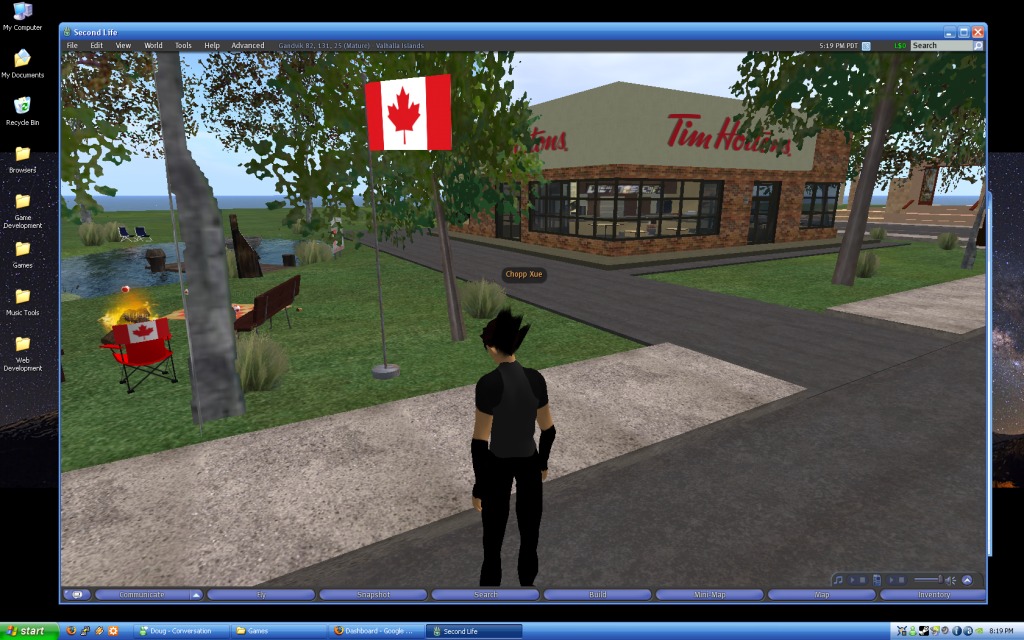
It just goes to show how realistic Second Life is, except that this is the only one I’ve seen in Second Life (in my hometown of 50,000 people there are 11 Tim Hortons coffee shops). Also, if you’re lucky you may spot camped out customers on the left! (users outside of Canada won’t get this joke… Canadians are nuts about their Tim Hortons coffee :) )
You might be a web developer. You might need to know what HTML element is under your cursor at any given time. You might need to know the hexadecimal value of a pixel is under your cursor at any time. You might have a mile-long CSS file inherited from multiple projects and wonder: “Which styles still apply and which are no longer used?”
Fear not my fellow web developers, web designers, programmers, whateverrers! These 5 Firefox Extensions will help you chop the time spent on any web development task so you can get back to reading blogs during the day. Or work. You choose.
Without further ado, here they are:
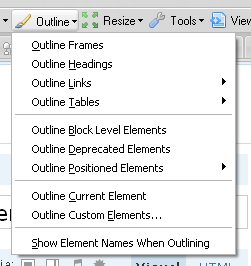
I don’t think I’ve ever used a web browser-based tool as much as I have this one. It’s saved me so much time and helped me solve so many problems over the past year. It does practically everything. With tools like “Resize Window” which lets you resize your window to a certain pixel width and height and “View Generated Source” which lets you see the source code used in the website AFTER Javascript runs — Instead of showing function(var 1, var 2) it will actually show the variables that went into that function e.g., function(“john”, “rockefeller”). Cool huh?
Cool features:
Sample Screenshots:

I’m sure we’ve all seen a cool color on a page, whether it’s an image or cell background, and said “Oh man I love that color. I could eat it. I wonder what the hex value is so I can use it on my site. Or in case I get hungry.” Well, you could always take a screenshot, load up The Gimp, use the Color Picker tool to determine the hex color value, but who needs to do that when you’ve got ColorZilla installed?
ColorZilla will display the hex color and RGB value of any color under your cursor. Very, very handy.

This handy little extension will show you the Google PageRank of whatever site you are on as well as the less-important-but-for-some-reason-still-used Alexa Ranking.

This handy little Firefox Extension will tell you which CSS styles are not found on your pages. It works per domain, so surf all of the pages of your site and a comprehensive collection of unused styles will be shown which you can then promptly delete from your stylesheet, thereby increasing the performance of your site.
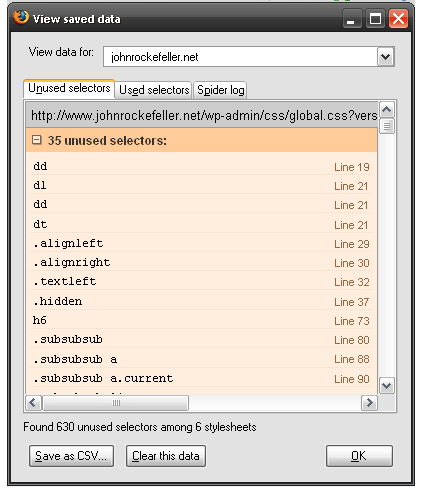
Very very, cool.
No Web Developer’s tool-belt would be complete without the illustrious Firebug. The list of features here is incredibly long, but so is the list of Web Developers who have saved hours of work using it. Their own website explains it better than I would but you’ve got to ask yourself one question: What kind of web developer are you if you aren’t already using this??
I hope you’ve enjoyed this list and found some of the links useful. If you’ve got something to say about these tools or even have a list of handy tools you use that might think others would find useful, please post a comment with a few links. Thanks!
If I had a lot of money…
I’d buy PlayOnLinux and Cedega and Crossover Games (while maintaining a great working relationship with the good folks still at Crossover working on apps) and put together (with some hefty funds behind them) a crack team of DirectX hackers and previous Microsoft DirectX programmers to put together a fully-functional, working DirectX emulator for Mac and Linux. Then, port all those changes back into the Wine trunk while promoting an off-the-shelf Windows games player.
I truly believe that if games worked on Linux flawlessly there would be a greater adoption of Linux on desktops worldwide. I know locally it is a huge hurdle to jump. All of my friends are interested in Linux, two of them have the ISO sitting on their desktop. Why are they not making the switch? One: Games. The other: Sony Vegas. People want to use it but they want their games too!
Game development and publishing companies wouldn’t have to write games to be cross platform if the emulator worked perfectly. They would go on making Windows games while Linux continues to grow in installed user base.
Making games for Linux is not the answer, making Linux work for games is!